

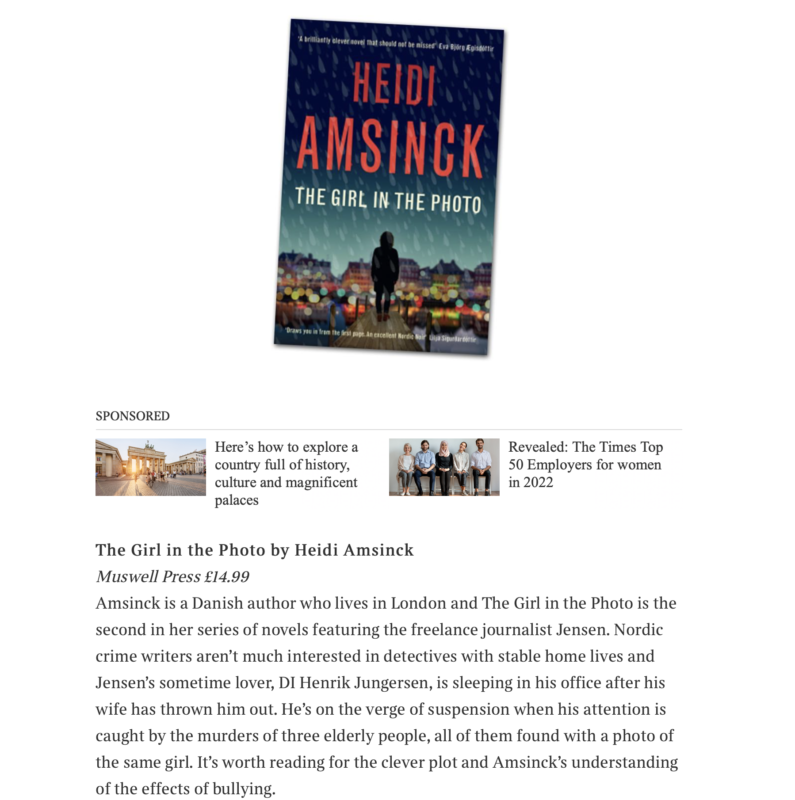
The Girl in the Photo features in Joan Smith’s Sunday Times crime books of the year selection.
https://www.thetimes.co.uk/article/best-crime-books-2022-2vdtqqkk5
The Girl in the Photo features in Joan Smith’s Sunday Times crime books of the year selection.
https://www.thetimes.co.uk/article/best-crime-books-2022-2vdtqqkk5
Published this week, Ethan Joella’s critically acclaimed novel, A Little Hope, has been described by the New York Times as ‘poignant and quietly powerful..inspiring.’ Here Ethan describes the emotional inspiration behind the book and his writing journey.
An abridged version of this article appeared on The Literary Sofa blog https://literarysofa.com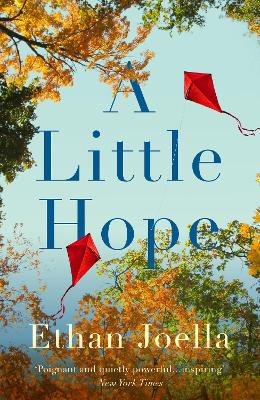
I had never faced full-on grief until my mother-in-law died in January 2016. I had experience with death, of course, and losing my grandparents and older relatives and even a few students and friends over the years was heartbreaking. But I could see my way through those deaths. This was something else.
Rebecca’s mother, Ann, had less than a year where she battled a deadly form of leukemia. She was only in her sixties. When she was diagnosed, the whole thing was unthinkable. I thought, my wife can’t lose her mom. The logical part of me wanted to set this cognitive dissonance right: Ann would need to survive, we would need to fix this. Rebecca and I were a couple who were good at fixing things—both Type A personalities, both over-achievers. But after hospitals in Philadelphia and New York City, chemo, radiation, and experimental treatments, the deadly disease finally won.
Her funeral was on the coldest day I can remember. The ground was frozen, and the sky above us was clear blue, with a few solitary snow geese punctuating the service.
A month later, in February, we were back in Rehoboth Beach, where we were living more and more, inching away from our old life in northeastern Pennsylvania, still trying to process what had happened. One Saturday, we drove our daughters to Ocean City for something to do. The weather was warm for a day in February, so we thought we’d walk the long boardwalk.
The wind was cold, but people were out on bikes, and there were so many dogs on leashes. The boardwalk was half summer and half winter: some stands open and some forgotten. We walked past arcade game music and boarded-up rides and there were fake dinosaur bones in the sand for kids to climb on.
I could not stop this feeling that we were limping.
Every so often, I looked at Rebecca, who was quiet but brave. Losing her mother had collapsed us. The world was not right without Ann. I kept thinking about the initial diagnosis in March and how I thought it was impossible that she could die. I felt foolish, rotten for telling Rebecca her mom would be okay, awful for not having any words of comfort for Ann whenever we’d see her. Her death had felt like simultaneous loss and failure.
We kept walking and finally got to the end of the boardwalk, where the ocean meets the bay. The view was worth the walk and the cold. The sun rested on the water. The waves were gentle. One old man held the railing and stared and stared. On the left, there was a life-saving station.
I looked at Rebecca, and realized we were doing the impossible. We had lost someone we couldn’t live without, as Anne Lamott says, and we felt abandoned. I missed hearing her mom’s voice and laugh. I missed when Rebecca would call her and tell her we got to Delaware safely. I missed the way we pulled up to Ann’s house with a new car and the excitement she would have. The way she would always listen to our plans (a job, a trip, a baby name), her green eyes twinkling. I missed her daringness: the recipes she tried, the way she’d remove her kitchen cabinet doors and wallpaper the insides, the antique fixtures she bought and repurposed in her house.
Her death had left a giant hole.
On the boardwalk, we turned back, and the wind was easier in this direction. It was then that at I noticed all the benches.
They were brown and each had a plaque.
For Lila who loved seashells in the morning and the boardwalk at night.
For our dad Roger Black who is always in our thoughts.
For Bob and Lucille: The beach isn’t the same without your smiles.
There was grief everywhere. It was like the Buddhist parable about the mustard seed my professor told us about in college. Every house has suffering, and this is part of life. That day, I hated that all these people sponsored these benches because they were hurting, too.
I kept reading and reading the plaques on those benches, and I looked over at Rebecca whose hair blew in wind, who lost a parent first. Who held her pain so calmly, her hands in her pockets as she answered questions our daughters kept asking her about the Ferris wheel, about riding their bikes later that afternoon.
I finally looked away from the benches. The way back seemed faster, and the girls posed for a picture by the dinosaur bones. I held Frankie’s bag of cotton candy.
The writer John Dufresne talks about writers facing the sadness and nobility of life. The sadness that we know we will all die but the nobility is that we still do all this anyway: fall in love, hold a child up in the air, buy ice cream and caramel corn and get wet in the ocean, our eyes watching for dolphins and banner planes in the distance.
I started to think about getting back to writing.
I had always loved to write, and I had a handful of novels I’d completed that would get me close to an agent, close to a good publisher, but never any further. With graduate school and young kids and working in two different states, my writing was the first thing I would cast to the side.
But that day, I thought of the carrying on we all do, the way we need to do the things the people we lose can’t do anymore, and I heard a phrase in my head. This is how we love them when they’re gone.
I thought about Ann not being able to vote in the upcoming November election. I thought about the fact that her house was still decorated for fall because she left home and didn’t come back. I thought about life as being something that rights the wrong, that the living must fight for the injustice of the dying and the dead.
I didn’t know how long it would take, but I knew that day I would write a novel that focused on love and loss and the things we do to bear it.
A year later and a half later, I had a solid draft together of a book, where one of my characters, Mrs. Crowley, says this: Well, we do the things they weren’t able to…We vote because they can no longer vote. We look at the ocean because they can’t. We think about them when we put up a Christmas tree, and later when we sit there and gaze at the lights. We do all the things they can’t. That is how we love them when they’re gone.
That day in Ocean City, our feet touched the weathered boardwalk that will more or less always be here for years and years, each plank replaced when needed but still the overall idea the same. I wondered if this is how we become wise. All these small reminders of mortality in our heads but still this daily celebration of nobility.
Our car sat by itself in its parking space in the street between two closed hotels, and Gia and Frankie waited by their doors. In the distance, a stray cat scurried by, and the music from a faraway car radio played something with too much bass. “It’s open,” I said, and they climbed in, the closing car doors reminding me of a Matchbox car I used to have when I was seven. I would hold it in my hands and open and click shut each tiny door, even the small hatchback. Did I ever dream I would be this age, this serious, this lucky being at the beach in winter with a family? Outside on the quiet street, I was alone with Rebecca. We stood behind the car that held our lives. I thought about how far we’d come from those kids we were when we started dating.
Now, Rebecca and I sighed and surveyed the sky. The sky that backdropped the rows of benches on the boardwalk. We were living, carrying on the best we could, our daughters needing us to keep going. And we would try to live well. For Ann and everyone else whose names were on the benches.
Click below to download our 2022 catalogue.
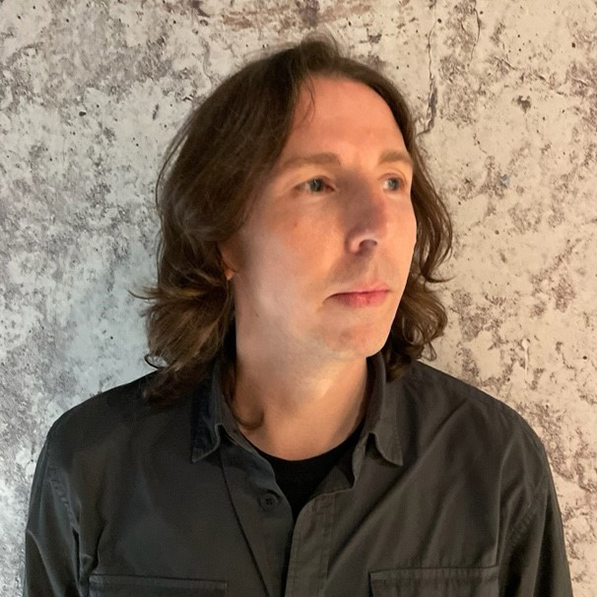
Published last week, Jon Ransom’s The Whale Tattoo has been causing quite a stir. As a queer working-class writer his route to publication was not the usual one, so we asked him to tell us about the genesis of his novel.
My mother died unexpectedly. Then my father was diagnosed with cancer everywhere at once. Afterwards, I became bewildered by death. That people can disappear from our lives so suddenly is unsettling. I figured the only way to navigate grief was to do something I found dangerous – write down the stories I had hidden inside my head. They appeared more like photographs, fragmented, incomplete and often surreal.
I started with the whale. I’d seen these huge and mysterious creatures washed up on the Norfolk coast. When out of water they appear disturbing and prophetic. Right away the thought that the whale, and later the water itself, could speak mesmerized me.
At this point Joe Gunner became my protagonist – a baffled working-class lad who believed death was chasing after him. I wanted him to be unlike the queer men I’d read about, who I sometimes admired, yet mostly couldn’t relate to. Joe had to be unapologetic and raw, like the lads I grew-up with.
Without any real sense of how to approach writing, I grabbed free moments on the bus, traveling to and from work, where I’d write small pieces of fractured prose on my mobile phone (the entire first draft of The Whale Tattoo was written this way). Immediately I liked the rhythmic element to my work, how it helped make pictures with words. Writing felt very visual and somehow musical. I just went with my instincts.
Joe’s world was always going to play out on the marsh and alongside the river (because much of my own experience sits here). This landscape shifts with light and the weather, and more often than not appears like an illusion. It is wild and can be unforgiving, perfectly fitting Joe’s unsettled state of mind. The rhythm here is controlled by the tides. They shape everything. The ebb and flow of the water became the pull that carried the characters along, always moving, sometimes backwards, frequently with no real understanding of what is beneath the surface. This uncertainty drove much of the writing – in the sense that I didn’t really know what I was doing both in my own life and in the world I was writing about. It did feel dreamlike and surreal, and this is how the nursery rhyme Row, Row, Row Your Boat found its way into the story (something my mother had sung to me as a child).
By now I was hooked. Obsessed with completing the story (even if it would be slight in length). I wanted to understand everything about Joe. The cyclical hate he experienced with his father and the Soldier. The way he and Fysh didn’t care to unpick their sexuality because they lacked the language and the desire to do so. I asked myself how much, if any, fate played in their world. Intrigued by the way I’d pulled in the colour red, Fysh’s hair, Birdee’s boat, the fireworks, I realised I’d tied huge elements of Joe’s life together with this surprising colour. It felt important. As did the concept of what is real and imagined. The more I wrote the further I thought about what can be conjured, these illusions that appear, and how much of the world is really ‘out there’ as opposed to inside our heads.
With the first draft of The Whale Tattoo finished I had to figure out what I would do with it. Unable to imagine not writing, I searched out opportunities to continue. I was awarded an Arvon grant to attend the residential course Fiction: Work in Progress. Then the recipient of an Arts Council England Free Reads prize. At the same time I’d been submitting short stories that were getting published here and in the US. Next I won a place on the National Centre for Writing 2019 Escalator mentoring scheme for early career fiction writers, where I was mentored by Anjali Joseph. A year later I signed with The Good Literary Agency who found a publisher for The Whale Tattoo shortly after. In April I was awarded a grant: Developing Your Creative Practice from Arts Council England, to fund my second novel The Gallopers.
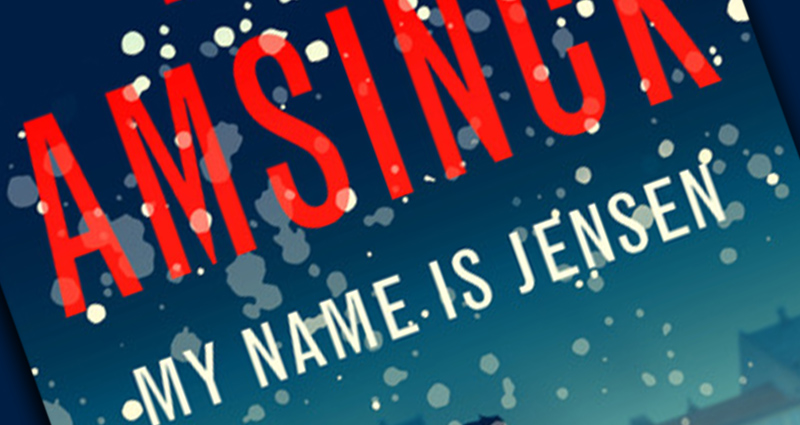
Review from The Sun. ‘JENSEN, a journalist who has lost her mojo, is making her way to work in Copenhagen when she discovers a body in the snow. It is the second homeless victim in as many weeks. When a third is found, it becomes apparent a serial killer is on the loose. Although initially reluctant to write about the murders, Jensen finds herself drawn to the case. But the deeper she digs, the more danger she unwittingly puts herself in. Despite all the gritty content, it is a beautifully crafted, atmospheric debut. 4/5’
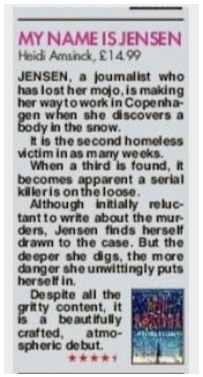
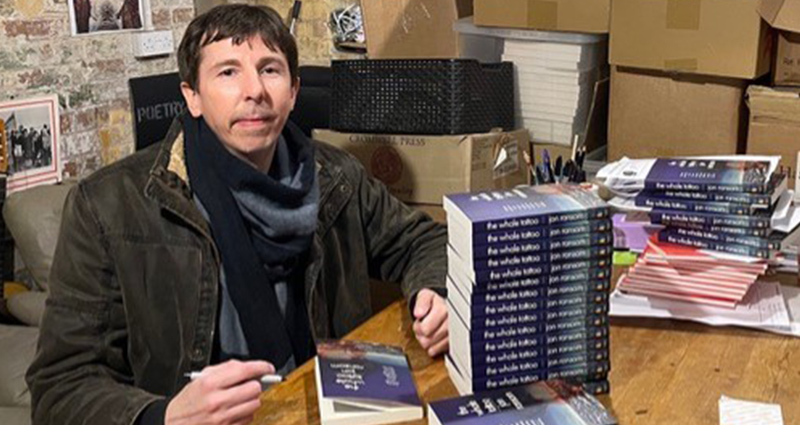
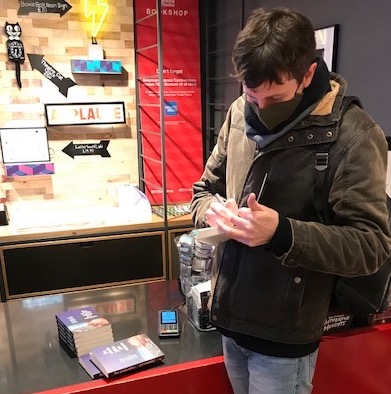
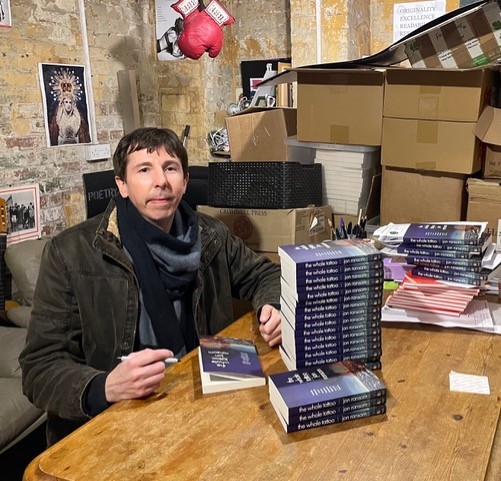
Celebrating publication Jon Ransom signed copies of his debut novel The Whale Tattoo at Gays the Word, Hatchards and the National Theatre Bookshop last week.
Jon Ransom launched the book on Damian Barr’s Literary Salon podcast, listen here https://tinyurl.com/27pd68dy and will be appearing at Polari Live Online https://tinyurl.com/2p92mc96
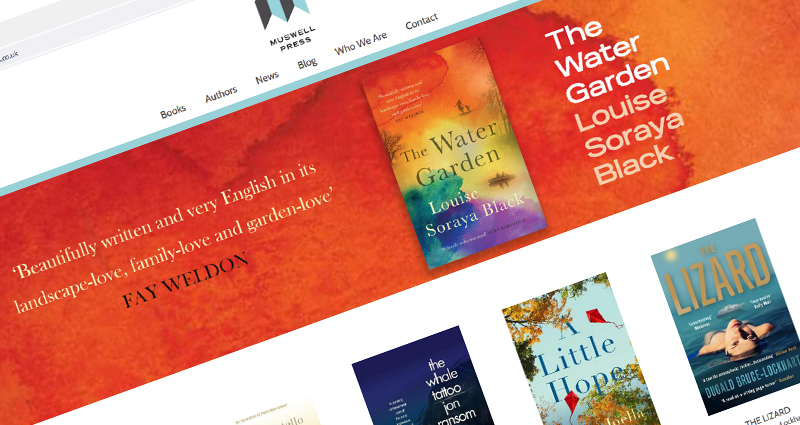
Welcome. We are really pleased to launch our new website and to offer you a better way to get to know our authors and their books. We’ve filled the site with everything you need to keep up to date with our brilliant new titles, and to find out what our authors are up to, search for previously published books, and to give you information about our exciting events and all the latest news from Muswell Press
You now have the opportunity to buy physical copies of our titles directly from Muswell Press. Having our own online bookshop means we and our authors benefit from a better profit margin on every book we sell. But you, the reader, benefit, too, as selling you books directly means we’re able to offer you special deals, signed copies and book bundles that will allow you to immerse yourself in some great books, whatever your budget.
We continue to support ethical retailers, of course, and we’re hugely grateful for the passion and enthusiasm with which they sell our books.
Almost all of our books are available in audiobook format. Downloads are available from all of the usual retailers, including Audible, Amazon, The Reading House, Storytel, Bookbeat, Apple and Google.
All our ebooks are available to buy from the site
The best way to keep up to date with of our latest news, deals and publications is to subscribe to our newsletter. It provides lots of exclusive subscriber-only content, plus special offers and giveaways. Go to the home page for details on how to sign up.
Over time our authors will be contributing stories and their own recommended reads to the site. We will also post author videos and let you know about online and physical author events.
We would love to hear from you. If you think there’s something missing from the site, or you want to see more of something, we’ll be really happy to hear your ideas. Get in touch with us via our contact page
Thank you so much for visiting.


